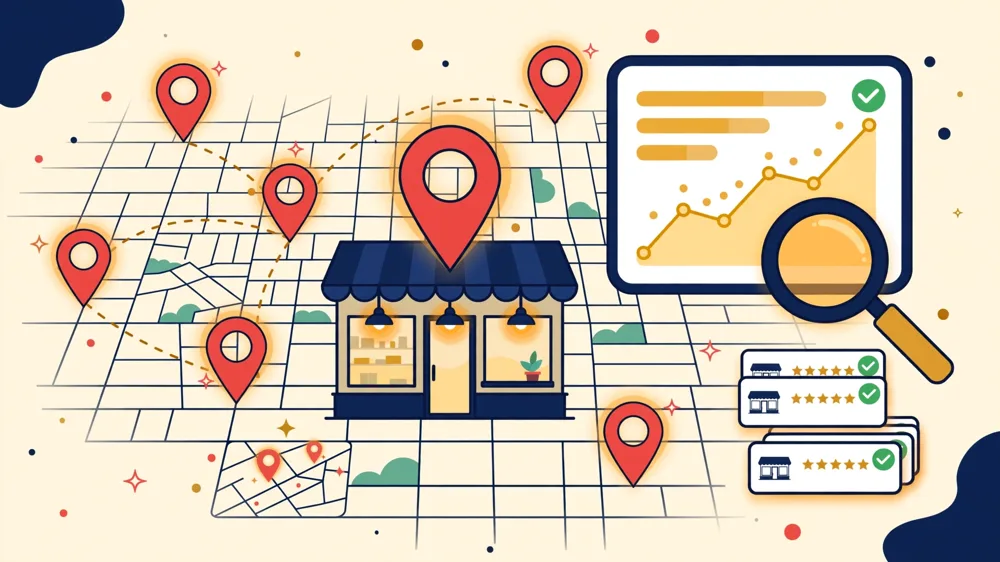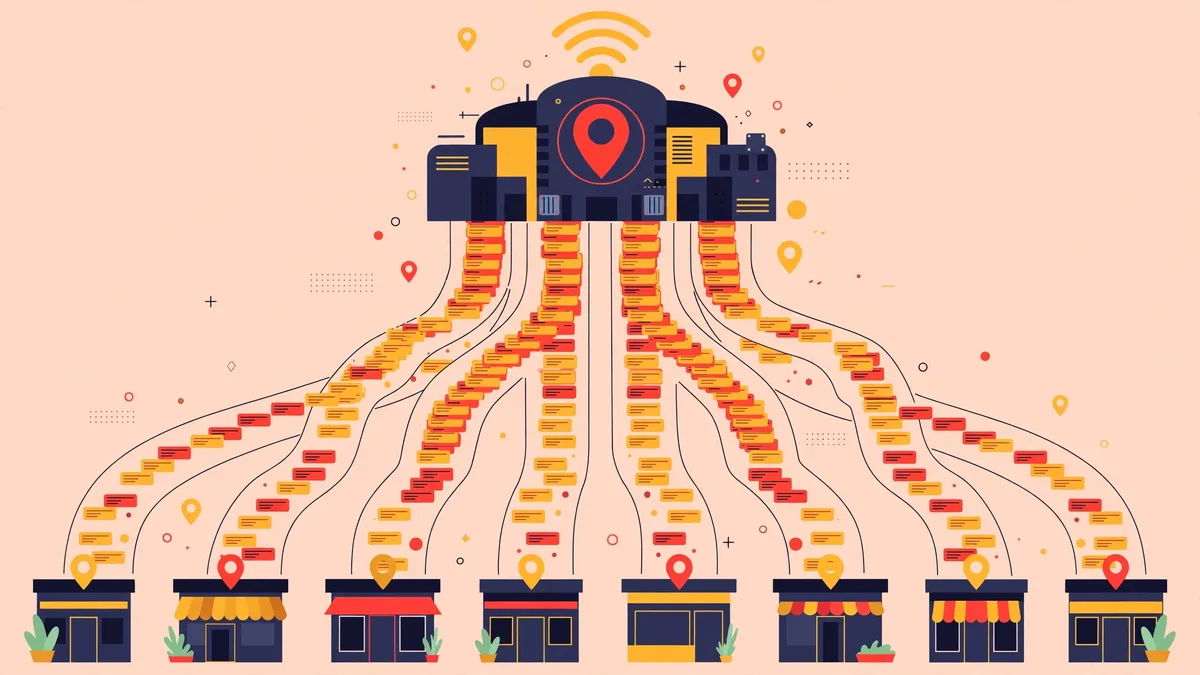
Underneath the directories you can see — the Yelp page, the chamber listing, the map pin — sits a layer most business owners never hear about: citation aggregators. These companies wholesale business data. They compile records for millions of businesses and sell or feed them onward to directories, apps, navigation systems and search services, which is why a business can appear on a website it has never visited.
This guide explains what aggregators are, who the real ones are, how their data flows, and — just as important — what they cannot do. It also explains our own position plainly: aggregator submissions are not part of our service, and this page will tell you why that boundary exists and what the alternative is.
Key takeaways
- Aggregators are wholesalers: one record in, hundreds of copies out.
- The US system runs mainly on Data Axle, Neustar Localeze and Foursquare.
- A wrong detail upstream keeps reappearing downstream — fix sources, not just copies.
- Aggregators move a thin record; complete directory profiles are a separate layer.
- Outside the US, the aggregator layer barely exists — directories are built directly.
What a Citation Aggregator Actually Is
Think of the local data ecosystem as retail and wholesale. Directories are the shops: each shows your business to its own visitors. Aggregators are the wholesalers behind them. An aggregator builds its database from public records, business filings, phone and utility data, partner feeds and direct submissions, then licenses that database to anyone who needs business listings at scale — directory publishers, app developers, car navigation systems, voice assistants and data resellers.
That is why your details can be wrong on a site you have never heard of: the site did nothing wrong except copy a record that was already wrong. And it is why fixing that one site may not last — the next feed refresh can quietly restore the error.
The Main Aggregators Today
Data Axle
One of the oldest US business-data compilers (formerly Infogroup). Its Express Update product is the route many tools use to push records into its database, which feeds a broad network of directories and search properties.
Neustar Localeze
A long-standing aggregator whose records feed directories, mapping platforms and voice services. It works mostly through partner platforms rather than direct business submissions.
Foursquare
A location-data company whose place database — expanded when it absorbed Factual — supplies countless apps and maps. Uniquely, it is also a consumer directory in its own right, and one businesses can list on directly.
Older guides often name Acxiom as the fourth major aggregator; it exited this market years ago, which is why articles still citing "the big four" are repeating history rather than describing the current system.
How the Data Flows — and Why Errors Come Back
The flow runs in one direction: sources feed aggregators, aggregators feed directories and apps, and those displays are what customers and search engines see. Two practical consequences follow. First, corrections travel slowly and unevenly — each downstream partner refreshes on its own schedule, so a fixed record can take weeks to replace the copies. Second, duplicates and variants multiply: if two upstream sources describe your business differently, downstream sites inherit both versions, and each looks like a separate business.
This is the mechanics behind the most frustrating citation problem owners report — the old phone number that will not die, which we walk through in our guide to fixing an old phone number on listings. The fix is always the same in principle: find the source records, correct those, then clean the visible copies.
What Aggregators Cannot Do
- They do not build complete profiles. The feed carries core data. The categories, hours, photos, descriptions and attributes that make a directory listing useful are added on the directory itself — or not at all.
- They do not remove duplicates. Syndication spreads records; it does not reconcile two records for the same business.
- They do not cover the long tail. Trade directories, local chambers and niche sites largely take direct submissions, not feeds.
- They are mostly American. The aggregator system is a US institution. In most of the 51 countries we work in, there is no equivalent layer — directories are built and maintained directly, one by one.
Our Position, Stated Plainly
Some citation sellers bundle "aggregator submissions" into their packages. We do not sell them, and we think you should know what that means either way. Where an aggregator offers a genuine direct route, a business can usually take it itself or through the platforms it already uses. What we sell is the controllable layer: complete, consistent listings built directly on the directories that fit your business, each one verified live and reported with its URL — the work described in our local citation services and checked by our free citation audit. If your audit shows an upstream record poisoning the well, the findings will say so, and the honest routes to fix it are the ones in the FAQ below.
Frequently Asked Questions
What is a citation aggregator?
A citation aggregator — also called a data aggregator — is a company that collects business information and wholesales it to hundreds of directories, apps, maps and search services. Instead of each directory researching your business itself, many copy the record from an aggregator.
Who are the main citation aggregators?
In the US, the three that matter today are Data Axle (formerly Infogroup, known for its Express Update product), Neustar Localeze, and Foursquare — which absorbed Factual and whose place database also powers many apps. Acxiom was once the fourth and exited the business-data market years ago.
Can I submit my business to the aggregators myself?
Partly. Data Axle offers a route for businesses to add or correct a record, and Foursquare accepts listings directly — it is a normal directory as well as a data supplier. Localeze works mainly through partner platforms rather than direct submissions. None of the routes is instant, and corrections propagate downstream on each partner's own schedule.
Do aggregator submissions replace building citations?
No. Aggregator data is a thin record — name, address, phone — flowing to sites that accept feeds. It does not create the complete profiles (categories, hours, photos, descriptions) on the directories customers actually browse, it does not fix duplicates, and outside the US the aggregator system barely exists. The two layers do different jobs.
Why does my old phone number keep reappearing on directories?
Usually because it lives upstream. If an aggregator record — or any widely-copied source — still carries the old number, directories that refresh from that feed re-import the error after you fix their own page. Lasting cleanup means finding and correcting the source, not just the copies.
Want the visible layer handled properly?
Manual citation building from $0.30 per citation — complete profiles on matched directories, verified live, with a full report.
See Packages Order Now